
AI Tools for Small Business India 2026: Complete Guide to Costs, Implementation & ROI
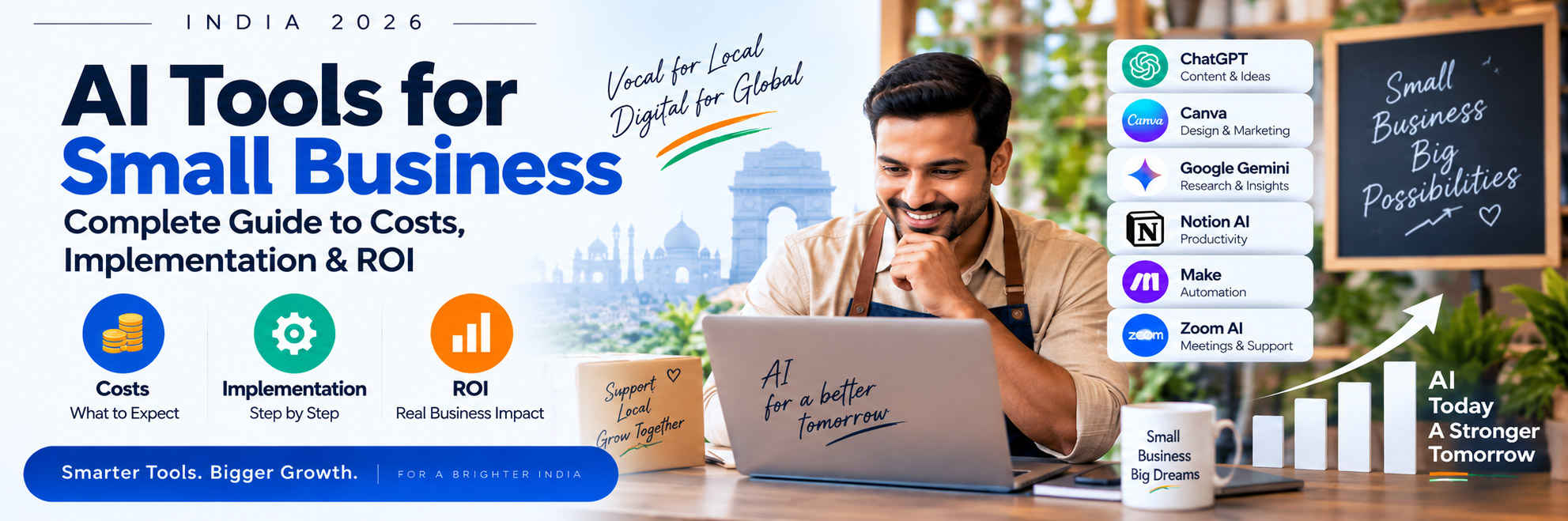
For an Indian small business owner, the question is no longer whether to use AI — it is which tools to pick, what they actually cost in rupees, and how to make them pay for themselves within 90 days. In 2026, a kirana store in Indore, a salon in Jaipur, and a 12-person export house in Tiruppur are all using the same core AI stack that costs less than a part-time employee, often under ₹5,000 a month.
This guide cuts through the hype. It gives you verified market numbers, a hands-on comparison of the 15 most-used AI tools for Indian SMEs, three ready-made stacks for different business sizes, step-by-step implementation, real cost calculations, and the mistakes that cause 30% of AI projects to be abandoned — so yours is not one of them.
Direct Answer: What Are the Best AI Tools for Small Business in India in 2026?
If you can only adopt four tools this month, start here:
- ChatGPT (Free or Plus at ₹1,700/month) — your all-round assistant for writing, data analysis, GST queries, and product descriptions in Hindi and English.
- Canva AI (Free, Pro at ₹3,999/year) — creates festival posters, Instagram reels, product banners and catalogues without a designer.
- WhatsApp AI via WATI or Interakt (from ₹2,499/month) — automates 70-80% of routine customer queries where 90% of Indian business conversations already happen.
- Vyapar or Zoho Books (Free tiers available, Vyapar premium ₹2,399/year) — handles GST-compliant billing, inventory and expense categorisation built for Indian compliance.
This core stack costs ₹3,000–₹5,000 per month total, saves 15–25 hours of weekly routine work, and is used by an estimated 47% of Indian SMEs in 2026 — up from just 12% two years ago. Add Zoho Zia for CRM automation and a voice agent like Bolna or Retell AI only after these four are running profitably.
Why 2026 Is the Tipping Point for AI in Indian Small Business
The Market Has Crossed Into Mainstream Adoption
India's AI market trajectory explains why tools are suddenly affordable and India-specific:
- Market size: IDC estimated India's AI market at roughly US$ 3.1 billion in 2020, growing to about US$ 7.8 billion by 2025 (around 20% CAGR). NASSCOM and BCG project US$ 17–22 billion by 2027, at 25–35% annual growth.
- MSME base: India has 63 million MSMEs — the largest small-business base in the world. Even a 20–30% adoption rate in this segment represents 12–19 million businesses.
- Adoption jump: Surveys of Indian SMEs show roughly 47% now use at least one AI tool in 2026, compared to about 12% in 2024. Globally, generative AI use among small firms jumped from 40% in 2024 to 58% in 2025 (U.S. Chamber data, mirrored in Indian metro surveys).
- Daily use: About 63% of small businesses report daily AI use, with 89% having at least one employee using AI every day (multiple 2025-26 SMB reports).
The gap between small and large firms is closing faster than any previous technology cycle. In early 2024, large enterprises used AI at 1.8 times the rate of small firms (11.1% vs 6.3% under strict production definitions). By mid-2025, the gap narrowed to about 10.5% vs 8.8%. Solo operators (1–4 employees) are showing the second-highest recent adoption rate — proof that the cost barrier has collapsed.
Why Costs Collapsed: Compute, Language, and Government Push
Three structural shifts made this possible:
- IndiaAI Mission: The Government approved ₹10,372 crore (about US$ 1.25 billion) over five years — including a common compute facility with 18,693 GPUs and an open GPU marketplace to lower access costs for startups and SMEs. A complementary initiative targets ₹10,300 crore specifically for the five-year mission window widely cited in 2024–26.
- Bhashini and Sovereign Models: Bhashini, the National Language Translation Mission under MeitY, provides free AI translation, speech-to-text and text-to-speech across 22 Indian languages. In early 2026, indigenous models like Sarvam's 30B and 105B-parameter LLMs trained on 16 trillion tokens across Indian languages launched, making Hindi, Tamil, Telugu, Malayalam and Bengali handling production-grade.
- Digital Public Infrastructure: ONDC (open commerce), UPI, and Aadhaar-verified identity give Indian AI builders consented, structured data that global tools lack — enabling better inventory, credit and logistics predictions for SMEs at lower cost.
Together, these pushed entry-level AI from an enterprise ₹50 lakh project in 2022 to a ₹3,000/month SaaS stack in 2026. Cloud AI costs for SMEs are declining 30–40% annually.
The Real ROI Indian Owners Report
Self-reported ROI should be read carefully — methodology matters. Transaction data (JP Morgan Chase Institute, Dec 2025) shows 17.7% of small businesses have actually paid for an AI tool, while 55–68% report having tried one. The businesses that moved from trial to paid use report:
- Time saved: 20–120 hours per employee per year on repetitive tasks; 58% of users report saving over 20 hours per month.
- Cost saved: 66% document savings of US$500–2,000 (₹42,000–₹1,68,000) per month; Indian micro-surveys translate this to ₹15,000–₹40,000 monthly for a 5–15 person firm.
- Revenue lift: 91% of SMBs using AI report revenue boosts (Salesforce 2024), and 73% say it improved competitiveness against larger rivals.
- Added income per rupee: One widely cited estimate for small business is US$3.70 returned for every US$1 invested in AI — among the highest technology ROIs — though results vary by workflow.
- Marketing time: 5–15 hours saved weekly on marketing tasks alone (HubSpot 2025); 95% of SMBs using AI for customer service report improved response quality.
Indian context: CPA Australia's Asia-Pacific small business survey (2024) found technology investments including AI improved profitability for 66% of Indian respondents — the highest in the region. Tool-using SMEs are nearly twice as likely to report year-over-year growth as non-adopters.
The 15 AI Tools That Actually Matter for Indian SMEs in 2026
We group tools by the job they do — not by hype. Every tool below has a free tier or sub-₹2,000 entry point, INR payment support, and proven use among Indian businesses.
Category 1: Writing, Research and General Business Assistant
1. ChatGPT (OpenAI) — The First Subscription to Buy
What it does: Drafts emails, WhatsApp broadcasts, product descriptions for Amazon/Flipkart, GST explainers, analyses CSV sales data, writes SOPs, translates English–Hindi–regional languages, and builds custom GPTs for repeat tasks.
Hands-on use: A boutique owner in Kochi replaced a ₹18,000/month freelance social media writer by using ChatGPT for captions + Canva for graphics. Another owner analyses monthly sales exports in ChatGPT Plus (code interpreter) to spot slow-moving SKUs in minutes.
- Pricing: Free tier on GPT-4o mini is genuinely useful; Plus at ~₹1,700/month (US$20) unlocks GPT-4o, file analysis, browsing and image generation.
- Hindi/regional: Excellent — handles code-mixed Hinglish well; always get a native speaker to review customer-facing regional copy.
- Best for: Every business owner who writes anything.
- Time saved: 5–8 hours/week.
2. Claude (Anthropic) — Best for Long-Form Work
What it does: Excels at 2,000+ word documents — detailed product guides, loan proposals, franchise disclosure documents, customer-facing documentation — with more consistent tone over long drafts than most rivals.
- Pricing: Free tier available; Pro at ~₹1,700/month.
- Best for: Agencies, exporters, consultants, and anyone writing proposals or compliance documents.
- Trade-off: Slightly less plug-and-play for Indian payment flows than Zoho/Google native tools.
3. Google Gemini — Best if You Live in Gmail, Docs and Sheets
What it does: Sits inside Workspace — summarises long email threads, drafts replies from Docs, analyses Sheets data, and pulls live web results better than most due to Search integration.
- Pricing: Free; Advanced at ~₹1,950/month (often bundled with Google One).
- Best for: Businesses already paying for Google Workspace.
- Rating in India hands-on reviews: 4.7/5 for ecosystem depth.
Category 2: Design and Visual Marketing
4. Canva AI (Magic Studio)
What it does: Removes the design bottleneck — generates festival packs (Diwali, Holi, Onam), Instagram carousels, product catalogs, menu cards, and short videos from a text prompt; background remover, magic expand, and brand kit.
- Pricing: Free is usable; Pro at ₹3,999/year (about ₹333/month) or ~₹500/month flexible. Teams at ₹6,999/year for 5 users.
- Why it wins in India: Localised templates, Hindi fonts, festival calendars — Western tools miss these.
- Verdict: 4.9/5 in Indian SMB reviews — the only design tool most SMEs need.
- Time saved: 3–5 hours/week.
5. Predis.ai — India-Built Social Media Engine
What it does: Generates Instagram posts, reels scripts, Hindi captions, and competitor analysis tuned to Indian aesthetic. Strong for solopreneurs who need daily posting without a team.
- Pricing: Free tier; paid from ~₹1,600/month.
- Best for: D2C brands, salons, cafes, coaching centres targeting Instagram.
Category 3: Customer Support and WhatsApp — Where 90% of Indian Queries Live
6. WATI — WhatsApp Business API Platform
What it does: Turns WhatsApp into your helpdesk: automated FAQs, product catalog, order confirmation, COD verification, appointment booking, broadcast, and human handover when AI confidence is low.
- Pricing: Growth at ₹2,499/month + WhatsApp conversation charges (Meta's per-conversation fee, utility vs marketing categories). Setup varies by partner, typically ₹15,000–₹40,000 if custom flows are needed.
- Strength: Built for India — UPI payment link integration, Hindi templating.
7. Interakt — WATI Alternative
What it does: Very similar to WATI — WhatsApp automation, shared team inbox, commerce flows. Many agencies prefer Interakt for its CRM view.
- Pricing: Growth at ₹2,499/month.
- Pick rule: Compare WATI vs Interakt on your existing CRM — both are credible; trial both for a week.
8. Tidio AI (Lyro) — E-commerce Website Chat
What it does: Plug-and-play AI chatbot for Shopify, WooCommerce and custom sites. Learns from your FAQ docs/website text and answers order-tracking, return and product questions 24/7.
- Pricing: Free for 50 handled conversations; paid from ~US$29/month (~₹2,500/month).
- Best for: D2C brands getting 50+ website chats a day.
- Rating: 4.4/5, 8.8/10 among Indian Shopify stores.
9. Freshworks Freddy AI — Helpdesk for Scaling Teams
What it does: Chennai-founded Freshworks' AI layer across Freshdesk/Freshsales — autonomous chatbots (Freddy AI Agent) plus agent-assist (Freddy Copilot) that drafts replies and summarises tickets.
- Pricing: Freshdesk from ~₹1,500/agent/month with Freddy add-on; free trial available.
- Best for: Businesses crossing 10+ customer queries per hour and needing SLAs.
Category 4: CRM, Sales and Automation
10. Zoho Zia — India's Native CRM Brain
What it does: Agentic AI across Zoho CRM, Books, Desk — scores leads, predicts deal closure, automates follow-up emails, flags stalled deals, and executes multi-step workflows (e.g., "if lead replies in Hindi, send Hindi catalog + create Books quote").
- Pricing: From ₹1,300/user/month; free trial. Zoho is fully INR-billed with India data centres.
- Why Indian SMEs love it: Cheaper than Salesforce/HubSpot, GST-ready, Hindi voice, and integrates with Bhashini-friendly flows.
- Rating: 4.6/5, native Indian ERP/CRM.
11. Zoho Books AI & Vyapar AI — Accounting That Speaks GST
Zoho Books: AI auto-categorises expenses, flags GST mismatches, predicts cash flow, and reconciles bank statements. Free for businesses up to 1,000 invoices/year; paid from ~₹1,200/month.
Vyapar: Built for retailers, traders and kirana shops — GST billing, inventory, party-wise ledger, offline mode, UPI collections, Hindi interface. Free basic mobile app; premium at ₹2,399/year (~₹200/month). Rating 4.8/5 — best for under ₹50 lakh annual revenue.
- Time saved: 3–5 hours/week on invoicing and reconciliation.
12. n8n / Zapier — The Glue That Connects Everything
What it does: Automates workflows like "new Razorpay payment → create Zoho invoice → send WATI confirmation → add row to Google Sheet" without code.
- Pricing: Zapier free for 100 tasks/month, paid from ~₹1,700/month; n8n is open-source self-hosted (free except hosting) or cloud from ~₹1,800/month.
- ROI trick: Automating one 30-minute daily manual task saves ~15 hours/month — often the fastest payback of any AI tool.
Category 5: Voice AI — The New High-ROI Frontier
13. Retell AI — AI Voice Agents for English-Leading Flows
What it does: AI voice agent that calls leads within seconds, qualifies them ("Budget? Timeline? Location?"), books appointments, and follows up after missed calls — handles hundreds of parallel calls.
- Pricing: Trial then from ~₹8,000/month plus per-minute telephony costs.
- Best for: Real estate, education, clinics, and home services where speed-to-lead wins.
- Time saved: 15–20 hours/week in tele-calling.
14. Bolna — India-Built Voice AI for Hindi and Regional
What it does: Same as Retell but optimised for Hindi and Indian accents, with better pronunciation for Tier 2/3 city prospects. Many agencies use Retell for English flows, Bolna for Hindi-dominant campaigns.
- Pricing: Similar to Retell, India-billed, often slightly lower per-minute for domestic calls.
Category 6: Knowledge and Operations
15. Notion AI — SOPs, Knowledge Base and Meeting Notes
What it does: Turns messy meeting transcripts into action items, Q&A search across all docs, and SOP drafting for onboarding.
- Pricing: ~US$8/user/month (~₹670/month).
- Best for: Remote teams, agencies, and digital-first SMEs with heavy documentation.
Complete Comparison Table: All 15 Tools at a Glance
| Tool | Category | Free Tier | Paid Price (INR) | Hindi Support | Best For | Time Saved / Week |
|---|---|---|---|---|---|---|
| ChatGPT | Writing / General | Yes | ₹0 / ₹1,700/mo | Excellent | Every business | 5–8 hrs |
| Claude | Writing / Long-form | Yes | ₹0 / ₹1,700/mo | Excellent | Proposals, guides | 4–6 hrs |
| Gemini | Writing / Workspace | Yes | ₹0 / ₹1,950/mo | Excellent | Gmail/Docs users | 4–6 hrs |
| Canva AI | Design | Yes | ₹333/mo (annual) | Templates | All SMEs | 3–5 hrs |
| Predis.ai | Social Media | Yes | ~₹1,600/mo | Good | Instagram-heavy | 3–4 hrs |
| WATI | No | ₹2,499/mo + Meta fees | Excellent | Service & retail | 6–10 hrs | |
| Interakt | No | ₹2,499/mo + Meta fees | Excellent | CRM-linked teams | 6–10 hrs | |
| Tidio (Lyro) | Website Chat | Yes (50 chats) | ~₹2,500/mo | Limited | D2C / Shopify | 5–8 hrs |
| Freshworks Freddy | Helpdesk | Trial | ~₹1,500/agent/mo | Good | Scaling support | 8–12 hrs |
| Zoho Zia (CRM) | CRM / Sales | Trial | ₹1,300/user/mo | Good | Sales teams | 5–8 hrs |
| Zoho Books | Accounting | Yes (1k invoices/yr) | ~₹1,200/mo | Good | GST filing | 3–5 hrs |
| Vyapar | Accounting | Yes | ₹2,399/year | Excellent | Retail / Kirana | 3–5 hrs |
| Zapier / n8n | Automation | Yes | ₹1,700/mo / free OSS | — | Connect apps | 5–15 hrs |
| Retell AI | Voice Agent | Trial | ~₹8,000/mo + mins | Decent | Lead calling | 15–20 hrs |
| Bolna | Voice Agent | Trial | ~₹7,000/mo + mins | Excellent | Hindi calling | 15–20 hrs |
| Notion AI | Knowledge / SOP | Yes | ~₹670/user/mo | — | Remote teams | 3–4 hrs |
Three Ready-Made AI Stacks for Indian SMEs — Copy This
You don't need all 15 tools. You need 4–6, picked for your revenue stage and applied consistently for 90 days. Here are the stacks we recommend to clients based on actual deployments.
Stack A: Starter (₹3,000–₹3,500/month) — For Revenue Under ₹3 Lakh/Month
For solo operators, kiranas, freelancers, and shops just starting digital:
- ChatGPT Free or Plus (₹0–₹1,700) — all writing, translations, product descriptions
- Canva AI Free or Pro (₹0–₹333) — festival offers, menus, social posts
- Vyapar Free or Premium (₹0–₹200) — GST billing and inventory
- Google Business Profile + Gemini Free — replies, posts, data analysis
Total: Under ₹3,500/month even at max. Handles: Content, basic accounting, posters, customer replies manually via WhatsApp Business (free) without paid chatbot yet.
Stack B: Growth (₹7,500–₹8,500/month) — For Revenue ₹3–₹10 Lakh/Month
For D2C brands, clinics, coaching centres, service businesses with 5–20 staff and 50–200 daily WhatsApp messages:
- All of Starter (ChatGPT Plus + Canva Pro + Vyapar or Zoho Books)
- WATI or Interakt (₹2,499) — WhatsApp automation and catalog
- Tidio Lyro or Freshworks (₹2,500) — website chat if you have e-commerce
- Zapier or n8n (₹1,700 or free self-hosted) — connect payment, invoice and sheet
Total: ₹7,500–₹8,500/month. Handles: 24/7 FAQ, order tracking, appointment booking, and automated invoicing — the typical 60–90 day payback point.
Stack C: Scale (₹15,000–₹22,000/month) — For Revenue Above ₹10 Lakh/Month
For agencies, manufacturers, and multi-location SMEs:
- All of Growth
- Zoho CRM with Zia (₹1,300/user × 3 = ₹3,900) — lead scoring, deal automation, sales follow-up
- Voice agent (Retell or Bolna, ~₹8,000) — lead qualification at scale
- Notion AI (~₹670 × 2 = ₹1,340) — SOPs, knowledge base, handover
Total: ₹15,000–₹22,000/month for a 5-person revenue team — still under 2–3% of monthly revenue for a ₹10 lakh business, which is the budgeting rule we recommend.
Budget Rule That Keeps You Safe
Never spend more than 2–3% of monthly revenue on AI tooling in the first six months. For a ₹5 lakh/month business, that's ₹10,000–₹15,000. For ₹1.5 lakh/month, it's ₹3,000–₹4,500. If your AI bill exceeds 5% of revenue, either pricing is wrong or you're paying for tools you haven't actually adopted into daily workflow. Revisit usage before adding more.
Step-by-Step: How to Implement AI in 30 Days Without Disrupting Business
Week 1: Find Your Bottleneck (2 Hours)
- List the 5 most repetitive tasks your team does daily — answering the same 10 WhatsApp questions, creating social posts, writing invoices, copying data between apps, or calling cold leads.
- Pick the one that eats the most hours and is easiest to measure. Good first targets: FAQs ("Price? Delivery? Timing?"), social content, and invoice creation.
- Measure the baseline: Hours per week, cost (₹ per hour × hours), error rate, and response time. Write this down — you cannot prove ROI without a before number.
Week 2: Run a One-Tool Pilot (5 Hours Over the Week)
- Choose one tool for that single bottleneck. FAQ overload → WATI/Interakt; design bottleneck → Canva AI; proposal writing → ChatGPT Plus.
- Set up the tool with real data — upload your actual FAQs, price list, or top 20 customer questions. Do not use dummy data.
- Run it with 5–10 real customer interactions per day and keep a human in the loop. For chatbots, set confidence thresholds: if AI is less than 80% sure, hand off to a human via the shared inbox.
- Train one owner — pick your most curious team member, give them the online tutorial and two hours of uninterrupted setup time. They become the trainer for others.
Week 3: Measure and Decide (3 Hours)
- Compare before vs after on four KPIs: Time saved (hours), money saved (hours × ₹/hour), response time (target: under 3 seconds for bots), and customer satisfaction (simple thumbs-up/down or CSAT).
- Walk through 5 chatbot conversations yourself. Are answers accurate, in the right language, and with the right tone? Fix hallucinations with better knowledge-base documents.
- Decision gate: If you saved at least 8–10 hours/week or cut response time by 50%, keep the tool and expand. If not, try a different tool for the same bottleneck — don't add a second bottleneck yet.
Week 4: Connect and Expand (6 Hours)
- Add automation: Connect the pilot tool to your next workflow via Zapier/n8n. Example: WATI new order → Vyapar invoice → WhatsApp confirmation.
- Add the second tool from your stack (typically Canva AI if you started with WhatsApp, or vice versa).
- Write a 1-page SOP in Notion or Google Docs: What the AI does, when it hands off to a human, who owns the numbers, and how to update FAQs. This prevents knowledge loss when staff changes.
After 30 days: Add one new use case per month, not per week. Businesses that add 1–2 well-measured use cases per quarter have a far higher survival rate than those trying five tools at once — Gartner predicts 30% of generative AI projects will be abandoned by end-2026 due to poor data, unclear value, and cost overruns when teams try too much at once.
Real Indian Business Examples — What Worked and What It Cost
Example 1: Kirana + General Store in Pune (2 Staff, ₹4 Lakh/Month Revenue)
Before: Owner answered 60 WhatsApp order messages a day, wrote GST bills by hand, and paid a local designer ₹4,000/month for offer posters.
Stack: Vyapar (₹2,399/year), Canva Pro (₹3,999/year), ChatGPT Free.
After: Vyapar handles billing and inventory with offline mode; Canva makes Diwali/New Year posters in 20 minutes; ChatGPT drafts WhatsApp broadcast messages for the society group. No paid WhatsApp bot needed at this message volume.
Result: Saves ~12 hours/week and ₹4,000/month in design fees. Total AI cost: ~₹534/month. Payback: Immediate.
Example 2: D2C Apparel Brand in Indore (8 Staff, ₹12 Lakh/Month, Shopify Store)
Before: 2 support staff handled "Where is my order?" tickets 10 hours a day; product descriptions took 3 hours per 20-item drop.
Stack: ChatGPT Plus (₹1,700), Canva Pro (₹333), Tidio Lyro (₹2,500), Zapier (₹1,700), Zoho Books (₹1,200).
After: Tidio answers 78% of order-status queries from tracking data; ChatGPT drafts product descriptions (human-edited) in 40 minutes per drop; Zapier auto-creates invoices and updates Sheets.
Result: Freed 1.5 headcount (reassigned to sourcing), cut response time from 4 hours to 90 seconds, saved ~22 hours/week. AI cost: ₹7,433/month vs. ~₹30,000 for the half-role it replaced. ROI: 4.0× in month two.
Example 3: Dental Clinic Chain in Delhi NCR (3 Locations, 18 Staff, ₹18 Lakh/Month)
Before: Receptionists spent 40% of time booking and rescheduling appointments via WhatsApp and phone.
Stack: Growth stack + WATI (₹2,499 + Meta fees ~₹1,200/month) + Bolna voice agent trial (₹7,000).
After: WATI shows live slots, takes bookings, sends reminders and reduces no-shows by ~22%; Bolna calls no-answer leads within 2 minutes and books 18% more consultations.
Result: 28 hours/week saved at reception, 31 additional appointments/month at ₹1,500 average value = ₹46,500 incremental revenue against ~₹10,700 added AI cost. ROI clearly positive by week six.
Example 4: Agency in Kozhikode (12 Employees) — The Freelancer Replacement That Improved Quality
Before: Agency paid ₹18,000/month to a freelance social media manager for 12 small clients.
Stack: ChatGPT Plus (₹1,700 total, shared), Claude (₹1,700), Canva Pro (₹333), Buffer for scheduling (~₹1,200).
After: Founder generates first-draft captions and briefs in ChatGPT/Claude (knows the clients deeply), Canva produces creatives, Buffer schedules. Quality improved because the founder's context plus AI was better than an outsourced freelancer guessing.
Result: Net saving: ₹18,000 − ~₹4,933 = ₹13,067/month with higher output consistency.
India's AI Cost Landscape for SMEs: What the Numbers Mean for You
From Enterprise Budgets to Small-Ticket SaaS
The same capability that cost Singapore-mid-market companies SGD 50,000–350,000 (₹31 lakh–₹2.2 crore) for custom AI implementations — chatbots starting SGD 50,000–100,000 — is now available to Indian SMEs as SaaS at ₹2,500–₹8,000 per month because models are pre-trained and infrastructure is shared. Geographic arbitrage also helps: India-based AI development costs 30–40% of Singapore consultant rates.
For most Indian SMEs, building custom AI is unnecessary. Plug-and-play SaaS covers 80% of needs. Only consider custom builds (₹5 lakh–₹50 lakh) when you have a clear, measured ROI and 12+ months of SaaS usage data proving the workflow value.
Hidden Costs to Budget For
- WhatsApp conversation fees: Meta charges per conversation (utility cheaper than marketing). A business sending 1,000 marketing broadcasts a month might pay ₹3,000–₹5,000 extra beyond the WATI fee — structure messages as utility (order updates) where possible to cut costs.
- Per-minute telephony for voice agents: Retell/Bolna + telecom minutes (often ₹0.80–₹1.50/min domestic). A 500-call month at 2 min average = 1,000 minutes = ₹800–₹1,500 extra.
- Data hygiene: A one-time 8–12 hour cleanup of product data, FAQs and GST ledgers pays for itself — bad data is the #1 reason pilots fail, cited in Gartner's 30% abandonment prediction.
Calculation That Convinces the Finance Mind
Take a real ₹6 lakh/month revenue business with 3 support staff at ₹20,000 each (₹60,000 payroll, 26 days, ~₹77/hour fully loaded):
- Current: Each staff spends 3 hours/day on repeat FAQs → 9 hours/day × 26 days = 234 hours/month costing ₹18,018.
- With WATI (₹2,499) + Tidio (₹2,500) automating 75% of that → saves 175 hours/month → effective payroll saved: ₹13,475.
- Net saving vs AI cost: ₹13,475 − ₹4,999 = ₹8,476/month + faster response → higher conversion (typically 5–10% more captures).
- Even one extra converted lead at ₹5,000 average order covers the entire AI stack.
Choosing the Right Tools: Decision Framework
Question 1: Where Do Your Customers Already Talk to You?
If 70%+ of queries are on WhatsApp → invest in WATI/Interakt first. If website chat dominates (D2C/e-commerce) → Tidio first. Don't invest in Instagram bots if your customers call you — match the channel, not the trend.
Question 2: What Language Do They Speak?
Hindi-dominant or Tier 2/3 audience → Bolna over Retell, WATI/Interakt (both Hindi-ready), Vyapar for Hindi billing. English-dominant metro audience → Retell, Freshworks, Gemini all perform well.
Question 3: What Are You Already Paying For?
Already on Google Workspace → Gemini Advanced gives outsized value. Already on Zoho (30+ million Indian users) → Zoho Zia/books/CRM integration saves double subscription pain.
Question 4: Build or Buy?
Buy SaaS first. Build custom only if: (a) no SaaS handles your specific workflow after 90 days of trying, (b) you have clean, documented data for 6+ months, and (c) the workflow touches revenue weekly and can justify ₹5 lakh+ build cost within a year.
| Decision | Choose SaaS | Consider Custom |
|---|---|---|
| Your workflow is common (FAQs, invoicing, posters) | ✓ SaaS | |
| Your data is messy, undocumented | ✓ SaaS — cleans as you go | |
| You need 22-language voice at scale (helpline) | ✓ Custom + Bhashini APIs | |
| Budget under ₹15,000/month | ✓ SaaS only | |
| Budget above ₹1 lakh/month and clear ROI | ✓ Evaluate custom |
Compliance, Privacy and Data — Non-Negotiables in India
DPDP Act 2023: What You Must Do
India's Digital Personal Data Protection Act now governs how you handle customer data — even when that data passes through an AI tool:
- Consent: Tell customers you use AI/automation for support (a line in your WhatsApp greeting or privacy policy suffices for most SMEs).
- Minimal data: Send only the data the AI needs — don't dump full customer databases into public LLMs for formatting. Use tools with India data residency (Zoho, Vyapar, WATI all offer it).
- Retention: Set a deletion policy — e.g., chat logs kept 90 days, invoices per GST law (6–8 years), marketing data per consent.
- Human review: For financial or legal answers (GST, medical, investment), always route AI drafts to a human before sending — hallucinated tax advice is a reputation and legal risk.
Bhashini as a Free Public Option
Bhashini is not a freemium funnel — it's a government-funded language platform providing free translation, speech-to-text and text-to-speech across 22 languages, built by MeitY with IITs. For small businesses needing translation of product descriptions or customer notices into 3–4 regional languages, Bhashini APIs at zero license cost beat paid translation SaaS.
Practical Safeguards
- Never paste full customer PII, Aadhaar, or bank details into public ChatGPT prompts. Use enterprise/teams tiers with data controls or Zoho-embedded AI that stays inside your tenant.
- Turn off model training on your data where offered (ChatGPT, Gemini settings).
- Keep an "AI use register" — one sheet listing which tool touches which data — for DPDP audit readiness. Takes 30 minutes, saves headaches.
Common Mistakes That Waste Months and Money
- Buying 5 tools at once: Teams try ChatGPT, Canva, WATI, Zoho and a voice bot in the same week — none get adopted. Phased rollout (one per month) has 3–4× higher adoption.
- Feeding garbage knowledge bases to chatbots: A bot trained on an outdated price list hallucinates confidently. One-day data cleanup before launch is the highest-ROI preparation you can do.
- No human handover: Bots that pretend to be human and never escalate frustrate customers. Always show "I'm an AI assistant, type 'human' to reach our team" and escalate when confidence is low.
- Judging on month one only: First 30 days include setup and learning. Measure payback at 90 days — most stacks break even at 60–90 days if the bottleneck was real.
- Ignoring WhatsApp Meta fees: Budgeting only the SaaS fee, then being shocked by conversation charges. Ask your WATI/Interakt partner for a monthly estimate based on your broadcast volume.
- Letting AI write legal/financial content without review: Google penalises AI-generated content that is unreviewed, and customers distrust hallucinated GST or tax advice. Always have a CA or owner review compliance copy.
- Training everyone at once instead of one champion: Train one enthusiastic owner first, then they train others. All-hands trainings before anyone has used the tool waste time.
Actionable 90-Day Plan to Make AI Pay
| Period | Action | Target Metric | Owner |
|---|---|---|---|
| Days 1–7 | Measure baseline; pick bottleneck; choose 1 tool | Baseline hours & response time documented | Owner |
| Days 8–21 | Pilot live with 10+ real interactions/day, human-in-loop | 50+ conversations handled, <10% error | Champion |
| Days 22–30 | Compare before/after; decide to keep or swap | ≥50% time cut or payback math positive | Owner + Champion |
| Days 31–60 | Add automation (Zapier/n8n) + second tool (Canva or WhatsApp) | 2 workflows live, SOP written | Champion |
| Days 61–90 | Add CRM or voice only if first two deliver; review DPDP register | Full stack ROI positive at 90 days | Owner |
KPIs to Track Weekly (15 Minutes on Monday)
- Hours saved per tool (estimated but logged)
- Response time: first reply (target under 3 sec for bot, under 4 hours for human)
- Containment rate: % of queries fully resolved without human (target 70%+ for mature FAQ bots)
- Conversion lift: leads captured vs prior month baseline
- Cost vs 2–3% revenue guardrail
FAQs: AI Tools for Small Business India 2026
1. Do AI tools really work in Hindi and other Indian languages in 2026?
Yes — production-grade. ChatGPT, Claude, Gemini, Bolna, WATI, Zoho Zia and Vyapar all handle Hindi well, including Hinglish code-mix. For Tamil, Telugu, Bengali and Malayalam, ChatGPT and Claude handle conversational drafts, while Bhashini and Sarvam models (built specifically for Indian languages) provide higher accuracy for customer-facing notices. Always have a native speaker review final marketing copy — fluency is good, cultural nuance still needs human touch.
2. How much should my small business budget for AI tools each month?
Use the 2–3% of monthly revenue rule for the first six months. Under ₹3 lakh/month revenue: ₹3,000–₹3,500 total (Starter stack). ₹3–10 lakh: ₹7,500–₹8,500 (Growth). Above ₹10 lakh: ₹15,000–₹22,000 (Scale). If your bill exceeds 5% of revenue, audit which tools are actually used daily — most teams find one or two subscriptions idle.
3. Which single AI tool should I start with if I can only pick one?
For any business that does writing, customer replies or product listings — ChatGPT (even free tier) plus Canva free. If most of your customer interaction is already on WhatsApp and volume is high (50+ messages/day), start with WATI or Interakt instead — it removes the biggest daily time drain directly.
4. Are there genuinely free AI tools good enough for business use?
Yes. ChatGPT (GPT-4o mini), Google Gemini, Canva Free, Notion (limited AI), Zoho Books free tier (1,000 invoices/year), Vyapar mobile free, and Bhashini translation (unlimited government-funded) together cover content, design, billing and language needs at zero subscription cost. Paid tiers mainly add volume, team seats and advanced file analysis.
5. Will AI reduce the need for staff in my small business?
For most SMEs, AI reassigns staff rather than removes them. Data shows 80%+ of AI-using SMEs believe AI helped expand — not shrink — their workforce, by freeing owners to do revenue work (sourcing, sales visits, partnerships) while AI handles routine tickets. In the examples above, an Indore D2C brand freed 1.5 roles to move to sourcing, a clinic freed receptionists to focus on in-person patient experience. Plan to reassign, not just cut.
6. How long does it take to see ROI from AI tools?
Most well-chosen pilots pay back in 60–90 days. Time-saving and reduced freelancer/design costs are immediate; revenue lift (more leads captured, fewer no-shows) appears from month two. Gartner's warning that 30% of genAI projects are abandoned refers mainly to businesses that skip the baseline measurement and try too many tools without clear value — phased measurement avoids this.
7. Is my customer data safe when I use these AI tools?
It depends on the tier and vendor. Reputable business tiers (ChatGPT Team/Enterprise, Gemini for Workspace, Zoho, WATI, Vyapar, Freshworks) offer India/in-region data residency and an option to opt out of training on your data. Avoid pasting sensitive PII (Aadhaar, full bank details, health records) into public consumer chatbots. For DPDP compliance, keep a one-page register of which tool touches which data and set a deletion policy.
8. What is Bhashini and should my business use it?
Bhashini is MeitY's (Ministry of Electronics & IT) Digital India initiative for language AI — free text translation, speech-to-text and text-to-speech across 22 Indian languages, built with IITs and research labs. For any business needing regional product descriptions, IVR, or customer notices in 3+ languages, Bhashini is a zero-cost alternative to paid translation SaaS and is already integrated into several Indian AI platforms.
9. Do I need technical skills or a developer to implement AI?
No for the 15 tools listed — all are no-code SaaS with templates. The typical setup is a 2-hour tutorial plus half a day of focused configuration. For Zapier/n8n automations, the first workflow may need a freelancer (₹3,000–₹8,000 one-time), after which you can clone it yourself. Custom AI builds do need developers and should only be considered after 6+ months of SaaS ROI proof.
10. What is the IndiaAI Mission and how does it help my business?
The IndiaAI Mission is the government's ₹10,372 crore initiative (2024–2029) to build shared AI infrastructure — including 18,693 GPUs, a marketplace for cheaper compute, support for homegrown LLMs (BharatGen, Sarvam-1, Bhashini), and AI labs for startups and MSMEs. For a small business, the direct benefit is cheaper, India-optimised tools — computing cost savings flow down as lower SaaS pricing and free language services like Bhashini. Indirectly, it funds skilling: over 18.5 lakh candidates have enrolled on FutureSkills PRIME, with 3.37 lakh completing AI courses.
11. Which AI tools are best for GST billing and accounting specifically?
Zoho Books (AI auto-categorisation, GST mismatch flagging, bank reconciliation) and Vyapar (offline billing, inventory, Hindi interface) are the two India-specific leaders. Zoho Books fits service businesses and larger SMEs needing full accounting; Vyapar fits retailers and kiranas under ₹50 lakh annual revenue who need speed at the counter. Both offer free tiers genuine enough to run a small shop for months.
12. Can AI tools integrate with my existing systems like Shopify, Tally or Zoho?
Yes — integration is the norm in 2026, not the exception. Tidio and WATI both plug into Shopify/WooCommerce; Zoho Zia is native across Zoho CRM/Books/Desk; Zapier/n8n connects 5,000+ apps including Tally, Razorpay, Google Sheets and WhatsApp. The one-time integration effort (half a day) typically saves 15+ hours/month of manual copy-pasting.
Conclusion: Start With the Bottleneck, Not the Buzzword
The Indian small business that wins with AI in 2026 is not the one with the most tools — it is the one that picks one painful bottleneck, automates it measurably, and compounds the saving over 90 days. The data is consistent: SMEs using AI save 20+ hours a month, 66% save ₹42,000–₹1,68,000 monthly at larger scale, and 91% report revenue improvement — but only among those who moved from experimenting to operating daily.
Your next step is not to research another month. List your five most repetitive tasks tonight, measure one baseline this week, and run a one-tool pilot with the appropriate Starter or Growth stack above. At 2–3% of revenue, the downside is a small, cancellable subscription; the upside is a team that finally has time to grow the business instead of just running it.
If you are evaluating suppliers, vendors or partners for AI implementation, finance or any business service, discover verified businesses, suppliers and service providers across India on Bizrato.com — India's Business Search Engine. For businesses ready to be discovered, list your business free on Bizrato Merchant and meet the customers already searching for what you do.