
Company Registration in India 2026: Private Limited, LLP & OPC — Costs, Documents & Step-by-Step Guide
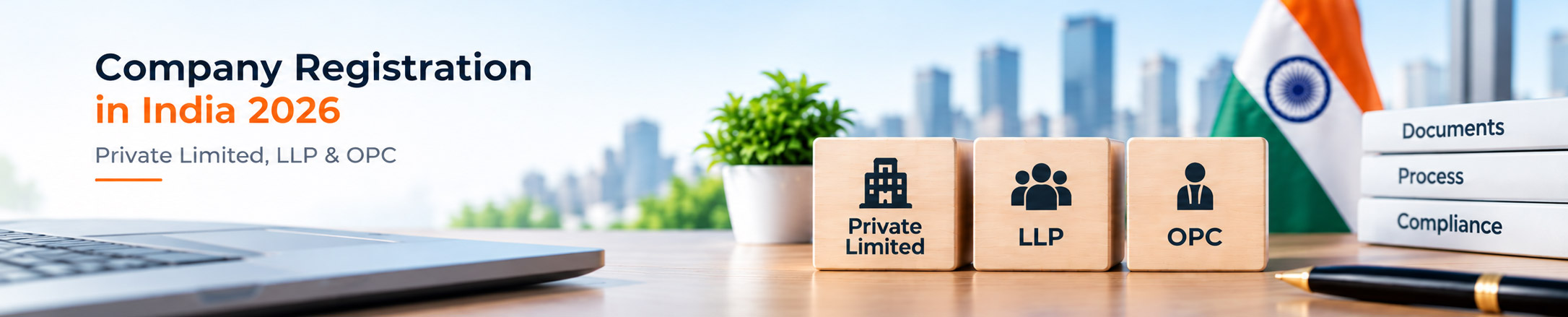
Registering your business correctly in 2026 is not paperwork — it is a strategic decision that determines how much tax you pay, how easily you raise funding, how much personal risk you carry, and how much annual compliance you live with for years. Yet most founders in India spend more time choosing a logo than choosing their legal structure.
In FY 2024-25, India registered 2.28 lakh new private limited companies and 64,000 new LLPs, taking the total to 24.8 lakh active companies and 3.2 lakh active LLPs. At the same time, the Ministry of Corporate Affairs now routes virtually every incorporation through a single window — SPICe+ (INC-32) on the MCA V3 portal — which bundles name reservation, director ID, PAN, TAN, EPFO, ESIC and even bank-account opening into one flow. Filing fees are nil for authorised capital up to ₹15 lakh, stamp duty remains state-specific, and Digital Signature Certificates (DSC) are now 100% mandatory for all filings.
This guide gives you the complete 2026 picture: which structure to pick, what it actually costs to register and maintain, the exact documents and timelines, step-by-step SPICe+ and FiLLiP filing, tax and funding implications, and the compliance calendar most blogs skip. By the end, you will know exactly which form to file and what to keep ready before you start.
The 30-Second Answer: Which Structure Should You Choose?
If you are building a fundable startup, product company or anything that may take VC/angel money, issue ESOPs or scale beyond ₹2 crore turnover — register a Private Limited Company. It is the only structure investors reliably fund, it supports equity, preference shares, convertibles and ESOPs, and it is the only structure eligible for DPIIT Startup India recognition that unlocks tax holidays.
Choose LLP if you are 2+ partners running a bootstrapped services, consulting, agency, or professional practice with no immediate fundraising plan and you want limited liability with lower annual compliance costs.
Choose OPC (One Person Company) if you are a solo founder who wants a separate legal identity and limited liability without finding a second director/shareholder — understanding that an OPC must convert to a private limited company if you cross ₹2 crore turnover or ₹50 lakh paid-up capital (the thresholds MCA has retained in 2026 for OPC conversion) and cannot easily take equity investment.
Still selling under a sole proprietorship or unregistered partnership? You carry unlimited personal liability. Conversion to LLP or private limited is worth doing the moment annual revenue crosses ₹30 lakh or you sign contracts with larger clients.
5 Legal Structures Every Indian Founder Must Understand
1. Sole Proprietorship
No separate legal entity. You and the business are one. Cheapest to start (GST or Shop & Establishment registration only), but unlimited personal liability — if the business owes ₹20 lakh, your personal savings and property are exposed. No equity, no ESOPs, no separate brand ownership. Best only for testing an idea or freelancing below ₹30 lakh turnover.
2. Partnership Firm (Indian Partnership Act, 1932)
Agreement between 2-20 persons sharing profits. Registered via Registrar of Firms in each state, or unregistered by deed. Still unlimited liability for partners. A partnership firm cannot issue shares, cannot be DPIIT-recognised as a startup, and investors avoid it. Use only for small traditional family businesses where all partners know and trust each other deeply.
3. Private Limited Company (Companies Act, 2013)
Governed by the Ministry of Corporate Affairs (MCA) and registered on mca.gov.in via SPICe+ (Form INC-32). Requires minimum 2 shareholders and 2 directors (can overlap), maximum 200 shareholders, separate legal entity, perpetual succession, limited liability to unpaid share capital. Most regulated, most credible, only structure that supports venture capital, ESOPs, and full Startup India benefits. Annual compliance is heaviest but manageable at ₹25,000-₹50,000 with a professional.
4. Limited Liability Partnership — LLP (LLP Act, 2008)
A hybrid of partnership flexibility and company protection. Requires 2 designated partners (one resident Indian), separate legal entity, limited liability to agreed contribution, no dividend distribution tax, no mandatory board meetings. Partners are not liable for each other's misconduct. Annual compliance is lighter: Form 8, Form 11, ITR-5. No statutory audit if turnover < ₹40 lakh AND contribution < ₹25 lakh. Cannot issue equity — investment comes as partner capital only, which deters VCs.
5. One Person Company — OPC (Companies Act, 2013, Section 2(62))
A private company with 1 member + 1 nominee (nominee takes over if member dies/becomes incapacitated). Gives a solo founder corporate existence without a co-founder. Same tax and compliance as a private limited company but exempt from holding AGMs and with relaxed board meeting rules. Cannot voluntarily convert to private limited before 2 years unless thresholds are crossed, and investors rarely fund OPCs — you will convert anyway to raise equity.
Full Comparison: Private Limited vs LLP vs OPC vs Sole Prop vs Partnership
| Parameter | Private Limited | LLP | OPC | Sole Proprietorship |
|---|---|---|---|---|
| Governing law | Companies Act, 2013 (MCA) | LLP Act, 2008 (MCA) | Companies Act, 2013 (MCA) | No central Act; GST/Shops Act |
| Members required | 2 shareholders + 2 directors | 2 designated partners | 1 member + 1 nominee | 1 owner |
| Maximum members | 200 shareholders | No limit | 1 (by design) | 1 |
| Separate legal entity | Yes | Yes | Yes | No |
| Liability | Limited to unpaid capital | Limited to contribution | Limited to unpaid capital | Unlimited — personal assets at risk |
| Can raise equity / VC | Yes — equity, prefs, convertibles, ESOPs | No equity; partner capital only | No — must convert first | No |
| DPIIT Startup India eligible | Yes | Yes (LLP also eligible since 2023) | Yes (but limited funding upside) | No |
| Foreign investment (FDI) | Automatic route via DPIIT | Allowed with approval in select sectors | Allowed but nominee must be resident Indian | Not allowed |
| Regulatory burden | High | Medium | Medium-high | Low |
What this means: If funding is even a 30% possibility in the next 3 years, start as a private limited company. Converting from LLP or OPC to private limited later is far more expensive (₹40,000-₹80,000 plus NCLT involvement for LLP) than starting correctly. Bootstrapped service businesses that will never raise equity should prefer LLP for the compliance savings.
What Company Registration Actually Costs in 2026
Most online ads quote "₹6,999 all inclusive" but hide DSC, stamp duty and professional fees. Here is the real breakdown as charged on the MCA V3 portal in 2026:
Government Fees (via MCA / SPICe+)
| Component | Private Limited / OPC | LLP (via FiLLiP) |
|---|---|---|
| MCA filing fee (SPICe+ Part B / FiLLiP) | Nil for authorised capital ≤ ₹15 lakh (MCA waived fee since 2021; still waived in 2026). ₹2,000 + for capital above ₹15 lakh, slab-based per Companies (Registration Offices & Fees) Rules | ₹500 for FiLLiP registration; ₹50 per document for supplementary filings |
| Name reservation (Part A of SPICe+) | ₹1,000 (included if you file Part A + Part B together; re-submission ₹1,000 again) | ₹200 via RUN-LLP |
| PAN + TAN application | ₹131 each, bundled inside SPICe+ (no separate filing) | Same — bundled inside FiLLiP |
| Stamp duty (MoA/AoA) | State-dependent: ₹1,000-₹7,500 for capital up to ₹10 lakh. Example: Maharashtra ~₹5,500 for ₹10 lakh capital; Delhi ~₹1,300; Karnataka ~₹3,000. e-Stamping via SHCIL is mandatory | Stamp duty on LLP Agreement; state-dependent ₹500-₹5,000 |
| DSC (Digital Signature Certificate) — 2 directors/partners | ₹800-₹1,500 per DSC (Class 3, 2-year validity from licensed CA like eMudhra, Sify). Budget ₹1,600-₹3,000 for two | ₹1,600-₹3,000 for two DPs |
| DIN (Director ID) for directors | Nil — generated inside SPICe+ Part B; no separate DIN filing needed | DPIN similarly generated inside FiLLiP |
Professional Fees (if you use a CA/CS — recommended)
| Service | Typical range 2026 (metro) | Typical range 2026 (Tier 2/3 via online platforms) |
|---|---|---|
| Private Limited full filing (end-to-end, incl. INC-9 declaration, AGILE-PRO-S, EPFO/ESIC, bank account opening) | ₹6,000-₹12,000 | ₹4,500-₹8,000 |
| LLP via FiLLiP + LLP Agreement drafting + filing Form 3 (within 30 days) | ₹5,000-₹9,000 | ₹3,500-₹6,000 |
| OPC registration | ₹6,000-₹10,000 | ₹4,000-₹7,000 |
All-In Cost Scenarios (Government + DSC + Stamp Duty + Professional)
| Scenario | Authorised capital | State example | All-in cost 2026 |
|---|---|---|---|
| Private Limited — leanest (self-file, Delhi stamp) | ₹10 lakh | Delhi (~₹1,300 stamp) | ₹4,500-₹6,500 (₹2,600 DSC + ₹1,300 stamp + ₹0 MCA) |
| Private Limited — typical with CA, Maharashtra | ₹10 lakh | Maharashtra (~₹5,500 stamp) | ₹12,000-₹18,000 |
| LLP (2 partners) via online platform | Contribution ₹2 lakh | Any state | ₹7,000-₹11,000 |
| OPC (solo) with professional | ₹10 lakh | Karnataka | ₹10,000-₹16,000 |
| Private Limited — capital ₹20 lakh | ₹20 lakh | Maharashtra | Add ₹2,000-₹3,500 MCA slab fee on top of above → ₹15,000-₹21,000 |
Hidden costs to budget: Notary/affidavit for INC-9 (₹200-₹500), AGILE-PRO-S linked bank account (zero balance but some banks push a minimum), and the mandatory declaration by professionals in INC-8 if you authorise a CA/CS. None of these exceed ₹2,000 combined.
Tax Comparison: Where Each Structure Wins or Loses
| Private Limited / OPC | LLP | |
|---|---|---|
| Tax on entity profits | 22% under Section 115BAA (concessional) + 10% surcharge + 4% cess = effective 25.17%, if you forgo other deductions. Else 30% normal rate. Startup with 80-IAC can be 0% for 3 years | Flat 30% + surcharge/cess. No 22% concessional rate |
| Dividend / profit distribution | Dividends taxable in shareholder hands at slab rate (up to 30%) → potential double taxation: 25.17% at company + up to 30% on dividend = blended ~43% if profits are fully distributed as dividend | Profit share exempt in partner hands under Section 10(2A) → only 30% at LLP, no second tax |
| Founder extraction strategy | Extract via salary to directors (deductible for company, taxed at slab) → effective 20.9% total for ₹50 lakh profit if fully paid as salary (no dividend). Most tax-efficient route for owner-operators | Remuneration to partners deductible subject to Section 40(b) limits; interest on capital also deductible |
| Carrying forward losses | Losses lapse if shareholding changes >49% (Section 79) — critical if you pivot ownership before profitability | No Section 79 restriction; partner change does not lapse losses |
| MAT / AMT | MAT not applicable if you opt for 115BAA | AMT at 18.5% may apply if adjustments claimed |
| Presumptive tax (Section 44AD) | Eligible if turnover ≤ ₹3 crore (≤₹4 crore if 95% digital receipts) — 8% deemed profit / 6% for digital | Same eligibility under 44AD for LLP/OPC |
Worked example for ₹50 lakh annual profit, founders extract 100%:
- LLP with two equal partners: LLP pays ~₹15 lakh tax at 30% effective → ₹35 lakh distributed tax-free to partners → partners pay no further tax on share, but if they also take remuneration the deduction shifts. Net tax ~₹15 lakh (30%).
- Private Limited distributing as dividend: Company pays ~₹12.58 lakh (25.17%) → ₹37.42 lakh dividend to shareholders taxed at slab; at 30% slab adds ~₹11.2 lakh → total ~₹23.8 lakh (47.6%). Clearly inefficient.
- Private Limited paying founders via salary (recommended): Company deducts ₹50 lakh salary → company taxable profit = 0 → founders pay slab tax on salary → at 30% slab each partner founder on ₹25 lakh pays ~₹5.22 lakh → total ~₹10.44 lakh (20.9%). Conclusion: Pvt Ltd wins on tax only if founders extract via salary, not dividend. LLP wins if you must distribute as profit share and stay in lower compliance.
Step-by-Step: Private Limited Registration via SPICe+ on MCA V3 (2026)
Every private limited and OPC incorporation now flows through SPICe+ (INC-32) on mca.gov.in. It is a single integrated web form in two parts. Do not use offline MCA forms — they are deprecated.
Before You Start — Preparation (Day 0, 1 hour)
- Choose directors and shareholders: Minimum 2 directors, at least 1 must be resident in India (stayed 120+ days in previous financial year). A director can also be a shareholder. Age 18+. DIN will be auto-generated; do not apply separately.
- Get Digital Signature Certificates (DSC): Required for all subscribers and directors. Use Class 3 DSC from licensed certifying authorities (eMudhra, Sify, NSDL). Video verification is mandatory since 2023. Validity 2 years.
- Create MCA V3 user account: Register with PAN, email and mobile at mca.gov.in. Enable business user type. This is where you file SPICe+.
- Decide authorised and paid-up capital: Authorised capital is the ceiling. Most startups choose ₹10 lakh authorised, ₹1 lakh paid-up (100% permissible). MCA fee is nil up to ₹15 lakh authorised, so do not inflate capital unnecessarily.
Filing Flow
- Part A — Name reservation: Inside SPICe+, click "New Application → Reserve name → SPICe+
Part A". Propose 2 name options in order of preference. Follow MCA naming rules:
- Name must not be identical to an existing company/LLP/trademark.
- Avoid generic words ("India Services Pvt Ltd") and regulated words (Bank, Stock Exchange, Insurance) unless you have approvals.
- End with "Private Limited" for Pvt Ltd, "(OPC) Private Limited" for OPC.
- Check instant availability on the MCA name search and trademark registry (ipindia.gov.in).
- Part B — Incorporation details: After Part A is approved, file Part B on the same SRN.
Sections:
- Company details: category (Company limited by shares), class, authorised capital, subscribers count, registered office address (can be residential initially; utility bill + NOC from owner required).
- Subscriber and director details: personal info, identity/address proof, educational qualification, occupation, share subscription per subscriber, class of shares, consideration.
- Capital structure: number of shares, nominal value (₹10 typical), paid-up value.
- AGILE-PRO-S section (linked filing): application for PAN, TAN, EPFO, ESIC, Profession Tax (Maharashtra), and opening of bank account via the AGILE organ — all auto-triggered; choose a bank from the listed 9 (SBI, PNB, ICICI, HDFC, Axis, Kotak, Bank of Baroda, Union, IndusInd in 2026).
- INC-9 declaration: subscribers and first directors declare no conviction/proceedings. Auto-generated; digitally sign.
- INC-8 declaration by professional (CA/CS/Advocate) if you engage one — mandatory when you use a professional's DSC for certification.
- Attach MoA and AoA (auto-generated e-MoA/e-AoA): Use e-MoA (INC-33) and e-AoA (INC-34) inside the portal. The system generates MoA/AoA based on your objects — edit main objects and ancillary objects carefully (avoid ultra-generic objects; MCA scrutinises "any business" clauses). E-sign with DSC of subscribers.
- Upload proofs: ID proof (PAN mandatory for Indians), address proof (Aadhaar/passport/voter ID + utility bill not older than 2 months), photograph, proof of registered office (electricity bill + rent agreement + NOC), and declaration for first directors (DIR-2 consent).
- Pay and submit Part B: If authorised capital ≤ ₹15 lakh, MCA fee ₹0 + stamp duty (system auto-calculates state-wise) + PAN/TAN fee if applicable. Payment via MCA wallet or net banking/UPI. Upon payment, SRN is generated.
- MCA processing and Certificate of Incorporation (COI): Central Registration Centre (CRC) at Manesar processes SPICe+. Clean filings get COI in 3-5 working days (many in 48 hours in 2026 for filings without quirks). COI carries CIN, PAN, TAN together — no separate PAN/TAN letters. Download from mca.gov.in → View Public Documents, or from your approved SRN dashboard. Bank account opening via AGILE is auto-initiated; you will get an email from the chosen bank to submit KYC and activate.
Immediately After Incorporation (First 20-30 Days — Do Not Skip)
- Open and credit paid-up capital: Subscribers must deposit subscription money into the company's newly opened bank account promptly.
- INC-20A (Declaration of commencement of business): File within 20 days of incorporation — declaration that subscribers have paid subscription money. Attachment: bank statement showing credit. Fee ₹200-₹300. Penalty for delay is ₹50/day for company and officers (up to ₹10,000).
- Appoint auditor: Board must appoint first auditor within 30 days via ADT-1. Info-only filing; no fee if filed within 30 days.
- Issue share certificates: Within 60 days, issue certificates in SH-1 format with stamp, signed by two directors.
- Maintain statutory registers: Register of members, directors, charges, minutes books — to be kept at registered office.
- GST registration if required: Mandatory if turnover > ₹40 lakh (services) or > ₹40 lakh (goods) / ₹20 lakh in special states; e-commerce sellers must register regardless of turnover. Use PAN-based registration on gst.gov.in.
- DPIIT Startup India recognition (optional): Apply on startupindia.gov.in or NSWS portal after incorporation. Requires company to be ≤10 years old, turnover ≤₹100 crore (₹200 crore after 2026 relaxation for deep-tech?), and working on innovation/scalability. Benefits: 80-IAC tax holiday setup, IPR rebates, public procurement relaxations.
Step-by-Step: LLP Registration via FiLLiP (2026)
LLP registration uses FiLLiP (Form for Incorporation of LLP) on mca.gov.in, plus a follow-up Form 3 (LLP Agreement) within 30 days.
- DSCs for designated partners: Same as above — 2 DPs need Class 3 DSCs.
- Name reservation (RUN-LLP): File RUN-LLP with two proposed names in order; fee ₹200. Approval in 1-2 days.
- Prepare FiLLiP: Enter LLP name, registered office, number of designated partners and partners, contribution details, business activity description.
- Attach proofs: Partner ID/address proofs, proof of registered office (utility bill + NOC/rent), DIR-2-like consent for designated partners, and subscriber sheet.
- Pay and file FiLLiP: Government fee ₹500 + PAN/TAN bundled. CRC processes; LL PIN is issued on approval in 3-5 days.
- Draft and file LLP Agreement (Form 3) within 30 days: This agreement defines profit share, capital contribution, rights/duties, meetings, profit distribution. Filing fee depends on contribution slab. Delay penalty ₹100/day. Do not copy templates blindly — define partner remuneration limits per Section 40(b), capital withdrawal rules, and dispute resolution (arbitration is common).
- PAN/TAN and bank account: LLP PAN is auto-issued via FiLLiP's PAN module; then open current account with incorporation certificate + LLP agreement + KYC of partners.
Step-by-Step: OPC Registration (2026)
OPC filing is SPICe+ identical to private limited, with three differences:
- One member, one nominee: File nominee's consent in Form INC-3 (nominee holds PAN and gives consent to be nominee). Nominee must be resident Indian and natural person.
- Name ends with "(OPC) Private Limited".
- Restrictions: OPC cannot carry out non-banking financial investment activities including investment in securities, cannot convert voluntarily to private limited or public limited before 2 years (unless thresholds crossed), and a person may be member/nominee in only one OPC.
Documents Checklist — Keep These Ready Before You File (Saves 7-10 Days)
| Document | For Private Ltd / OPC | For LLP | Notes for 2026 |
|---|---|---|---|
| PAN card | Mandatory for all directors/subscribers (Indian) | Same for designated partners | For foreign directors, passport mandatory; PAN not required at incorporation but needed later for DIN KYC |
| ID proof | Aadhaar / passport / voter ID / driving licence | Same | Aadhaar is most accepted for address+ID; ensure Aadhaar-PAN linked |
| Address proof (personal) | Utility bill (electricity/phone) ≤2 months old + bank statement if needed | Same | Must match MCA records; mismatch is #1 reason for query |
| Photograph | Passport-size, white background, ≤6 months old | Same | Digital upload; no attestation needed if e-signed |
| Proof of registered office | Latest electricity bill (≤2 months) + rent agreement + NOC from owner (on letterhead if owned premises) | Same | Residential address is permitted; NOC must say "consent to use as registered office" |
| DSC | Class 3 for each director/subscriber | Class 3 for each designated partner | Buy from MCA-licensed CA network (eMudhra etc); keep password safe — needed for every MCA filing |
| DIR-2 consent + INC-9 declaration | Yes — auto-generated in SPICe+ | Consent for DP | Digitally signed; not physically printed |
| MoA/AoA or LLP Agreement | e-MoA (INC-33) + e-AoA (INC-34) auto-generated; capital clause is critical | LLP Agreement (Form 3) within 30 days | Objects clause should be specific (e.g. "retail trade of garments via ecommerce" not "any business") |
| For Startup India (post-incorporation) | Incorporation certificate + MoA/AoA + website/pitch deck + director details + DPIIT form on NSWS | Incorporation cert + LLP Agreement + pitch deck | DPIIT recognition is not automatic on incorporation — separate application |
Timeline: How Long Does Registration Actually Take?
| Stage | Private Limited (SPICe+) | LLP (FiLLiP) | OPC |
|---|---|---|---|
| DSC procurement | 1-2 days (video KYC) | 1-2 days | 1-2 days |
| Name reservation (Part A / RUN-LLP) | 1-2 days | 1-2 days | 1-2 days |
| Part B / FiLLiP preparation + e-sign | 1 day if documents ready | 1 day | 1 day |
| CRC processing to COI / LL PIN | 2-5 working days (48 hours for clean cases) | 3-5 working days | 2-5 working days |
| PAN/TAN auto-issue | With COI itself | With LL PIN | With COI |
| Bank account activation (AGILE-linked) | 3-7 days after COI | 3-7 days (separate bank KYC) | 3-7 days |
| INC-20A + auditor appointment window | 20 days + 30 days | — | 20 days + 30 days |
| Total end-to-end (documents ready) | 5-8 working days to COI | 6-10 working days to LL PIN + 30 days for LLP Agreement | 5-8 working days to COI |
What slows you down in practice: name rejection (add a distinctive word — avoid "India", "Global", "Solutions"), address proof mismatch, missing NOC for residential office, and foreign director KYC. Budget 2 extra days for each re-submission.
Post-Registration Compliance Calendar You Cannot Ignore
Registration is the start line. Non-compliance penalties compound daily. Here is what every structure must file:
Private Limited & OPC — Annual Obligations
| Form / Due | What | When | Penalty for delay (2026) |
|---|---|---|---|
| INC-20A | Declaration of commencement | Within 20 days of incorporation | ₹50/day up to ₹10,000 + company cannot borrow or commence operations without it |
| ADT-1 | Auditor appointment | Within 30 days of incorporation | ₹50/day |
| AOC-4 | Financials filing with ROC | Within 30 days of AGM (AGM must be within 6 months of FY-end; 9 months in first year) | ₹100/day (company + officers) |
| MGT-7 | Annual Return | Within 60 days of AGM | ₹100/day |
| MGT-14 (if applicable) | Filing of board/shareholder resolutions | Within 30 days of resolution | ₹100/day |
| DIR-3 KYC | Director KYC (every director) | By 30 September annually | ₹5,000 fee after due date, DIN deactivated |
| DPT-3 | Return of deposits / exempted loans | By 30 June annually | ₹100/day |
| Income Tax Return (ITR-6 for company) | Company ITR | 31 October (if audit) / 31 July (if no audit) | As per Income Tax Act + interest |
| MSME Form-1 (if applicable) | Disclosure of outstanding payments to MSME suppliers >45 days | 31 October & 30 April (half-yearly) | Penal consequences under Companies Act |
| GST returns | GSTR-1, GSTR-3B (monthly/quarterly), GSTR-9 annual | Monthly 11th/20th or quarterly under QRMP | ₹50/day (₹20 for nil), late fee caps |
LLP — Annual Obligations
| Form / Due | What | When | Penalty |
|---|---|---|---|
| Form 11 | Annual return | Within 60 days of FY-end (by 30 May) | ₹100/day |
| Form 8 | Statement of Account & Solvency | Within 30 days of 6 months from FY-end (by 30 October) | ₹100/day |
| ITR-5 | LLP income tax return | 31 July (no audit) / 31 October (audit) | Per IT Act |
Annual professional cost estimate (2026, without GST): Private Limited ₹25,000-₹50,000; LLP ₹8,000-₹15,000 (no audit) / ₹20,000-₹30,000 (with audit); OPC ₹20,000-₹35,000. This is not optional — non-filing for 2 consecutive years invites ROC striking off the company.
New in 2026: What Changed That Founders Should Know
- MSME classification limits enhanced from 1 April 2025: Micro = investment ≤₹2.5 crore & turnover ≤₹10 crore; Small = ≤₹25 crore & ≤₹100 crore; Medium = ≤₹125 crore & ≤₹500 crore (PIB PR ID 2098389). More companies now stay inside MSME for longer — relevant when you seek MSME priority-sector lending or Udyam registration post-incorporation.
- CGTMSE cover doubled to ₹10 crore: Budget 2025 enhanced guarantee cover for micro and small enterprises from ₹5 crore to ₹10 crore, unlocking an estimated ₹1.5 lakh crore in additional collateral-free credit. Registering as a company/LLP with Udyam is the gateway to this cover.
- MCA V3 + Central Registration Centre discipline: Name scrutiny is stricter in 2026. Avoid plugging "India" or city names without distinctive elements. CRC now flags MoA objects that are copy-pasted generic text — draft 3-5 specific main objects instead of 20 vague ones.
- Startup India turnover threshold under discussion for 2026-27: DPIIT has consulted on extending the startup recognition turnover limit handling — verify the live rule on startupindia.gov.in before applying; the Playbook (April 2026) emphasises that DPIIT recognition does not automatically grant 80-IAC — you must apply separately to the Inter-Ministerial Board (IMB).
- Udyam Helpdesk integration via NSWS: New companies are nudged to register on Udyam immediately after incorporation — useful for 45-day MSME payment protection, TReDS invoice discounting, and GeM procurement preference.
How Registration Links to Startup India, Udyam and Funding
Company registration alone does not unlock benefits. Three parallel registrations matter:
| Registration | Where | Cost | What it unlocks |
|---|---|---|---|
| Company/LLP (SPICe+ / FiLLiP) | mca.gov.in (MCA V3) | ₹5k-₹18k all-in | Legal entity, limited liability, bank account, ability to contract |
| Startup India DPIIT Recognition | startupindia.gov.in or NSWS portal | Free | Eligibility to apply for 80-IAC tax holiday, angel tax exemption, IPR fee rebates (80% on patents), self-certification, public procurement relaxations, SIDBI Fund of Funds, Credit Guarantee Scheme for Startups (up to ₹5 crore cover in 2026, ₹20 crore for specified sectors) |
| Udyam (MSME) Registration | udyamregistration.gov.in | Free, instant | Priority sector lending at 1-2% lower rate, CGTMSE collateral-free loans, GeM marketplace access, TReDS invoice discounting, 45-day payment protection via Samadhaan |
DPIIT recognition criteria (collated from Startup India Playbook April 2026 + Tax Playbook May 2026): entity must be private limited company or LLP or registered partnership; incorporated ≤10 years ago (20 years for deep-tech); turnover ≤₹100 crore in any year (₹200 crore proposed for deep-tech/long-window startups — verify live notification); working toward innovation/improvement/scalability; not formed by splitting an existing business. Apply with incorporation certificate, MoA/LLP deed, website/pitch deck, director details. Recognition is typically granted in 3-7 days.
80-IAC tax holiday (Section 80-IAC) — the detail most blogs gloss over: Only Pvt Ltd and LLPs are eligible (not OPC sole prop, not unregistered). Startup must be incorporated on or after 1 April 2016 and before 1 April 2030, hold an IMB certificate for "eligible business," and can claim 100% deduction on profits for any 3 consecutive years within the first 10 years from incorporation — not necessarily the first 3. Turnover in the year of claim must be within limit (₹100-₹150 crore depending on notification in effect). You claim at ITR filing time after IMB approval — DPIIT recognition alone is insufficient.
Decision Framework: Which Structure for Your Situation?
Use this 5-question check before you file:
- Will you raise equity in 3 years? → Pvt Ltd. Even if the answer is "maybe," choose Pvt Ltd.
- Are you 2+ partners, no funding, profit distribution is priority? → LLP. Saves ~₹15k-₹30k/year in compliance and avoids double dividend tax.
- Are you solo, want credibility, no funding horizon? → OPC. Budget for conversion later (₹15k-₹25k) when you add a co-founder or investor.
- Is annual profit > ₹40 lakh and you want lowest effective tax via profit share? → LLP edges ahead (30% flat, no second tax).
- Do you need Startup India benefits immediately? → Pvt Ltd or LLP (both eligible), but Pvt Ltd gives broader access to Fund of Funds and VC-friendly instruments.
Real Indian Examples
- Bengaluru SaaS — 2 co-founders, angel round planned in 12 months: Started as LLP to "save fees" → had to convert to Pvt Ltd for term sheet. Conversion via LLP-to-company route required NCLT process, took 3 months, cost ₹68,000 in professional + filing, and lost the original incorporation date for DPIIT age calculation. Lesson: start Pvt Ltd.
- Indore garment manufacturer — 3 partners, bootstrapped, ₹1.2 crore turnover, no funding plan: LLP at ₹9,000 incorporation, ₹11,000 annual compliance, 30% tax on profit with tax-free distribution. Pvt Ltd would have cost ₹38,000/year more in compliance with no funding upside.
- Kochi freelance designer → product studio: Started as OPC in 2024 at ₹12,000. Crossed ₹2.1 crore turnover in FY25 — now mandatory conversion to Pvt Ltd (filing INC-6). Budgeted ₹18,000 for conversion plus amended MoA.
Common Mistakes That Cost Weeks and Money
- Picking a name without trademark search: MCA may approve a name that later draws a trademark opposition from a senior brand. Always check ipindia.gov.in + mca name search + domain availability before Part A. Add a distinctive invented word ("Nivara Retail Pvt Ltd" beats "Best Retail Pvt Ltd").
- Using a residential address without a proper NOC: CRC rejects filings where the electricity bill is in a parent's name but the NOC is missing or says only "residence" instead of "registered office." Get a one-line NOC: "I, [owner name], owner of [address], consent to use as registered office of [proposed company]."
- Inflating authorised capital to "look bigger": Authorised capital is not paid-up capital and does not impress investors. Keep it at ₹10 lakh unless you have a clear capital plan; stamp duty and future capital increase fees both rise with authorised capital.
- Delaying INC-20A: This is the most missed deadline. Without INC-20A, ROC marks the company as non-compliant and blocks charge creation, borrowing, or even voluntary closure via STK-2. File within 20 days even if capital is just ₹1 lakh.
- Copy-pasting MoA objects from a template: MCA scrutinises objects. "To carry on any business" gets queried. List 3-5 precise main objects (e.g. "retail trading of apparel via online and offline channels") plus ancillary objects that actually support them.
- Assuming DPIIT = 80-IAC automatically: About 40% of recognised startups never apply separately to the Inter-Ministerial Board for 80-IAC eligibility. DPIIT recognition alone does not waive tax — you must obtain the IMB certificate and then claim in the ITR of the chosen 3-year window.
- Not registering on Udyam immediately: Udyam is free and takes 10 minutes on udyamregistration.gov.in with Aadhaar + PAN. Without it, banks treat you as a general borrower, not a priority-sector MSME borrower — interest rates are 1-2% higher and CGTMSE guarantee is unavailable.
Actionable Checklist: From Idea to Incorporated in 8 Days
| Day | Action | Owner | Cost |
|---|---|---|---|
| Day 0 | Finalise founders, capital split, registered office address; run name + trademark + domain checks | You | ₹0 |
| Day 1 | Procure DSCs for all directors/DPs; create MCA V3 account | You/CA | ₹1,600-₹3,000 |
| Day 1-2 | File Part A (name reservation) with 2 options + main objects draft | CA/CS or self | ₹1,000 |
| Day 3 | On name approval, complete Part B + AGILE-PRO-S + e-MoA/e-AoA + INC-9; e-sign; pay stamp duty + PAN/TAN | CA/CS or self | State stamp ₹1,300-₹5,500 |
| Day 3-6 | CRC processing; track SRN on mca.gov.in → Services → Track SRN | — | ₹0 |
| Day 6-7 | COI + PAN/TAN issued; trigger bank KYC via AGILE email; open current account | You + bank | ₹0 (bank may ask for initial deposit) |
| Day 7-20 | Deposit subscription money; file INC-20A; appoint auditor (ADT-1) within 30 days | CA | ₹200-₹500 (filing) |
| Day 10-15 | Apply for GST (if needed) + Udyam + DPIIT Startup India recognition | You/CA | ₹0 (Udyam+DPIIT free) |
Frequently Asked Questions
1. What is the cheapest way to register a company in India in 2026?
The cheapest compliant route for a private limited company with ₹10 lakh authorised capital is self-filing via SPICe+ on mca.gov.in with 2 DSCs and Delhi stamp duty — about ₹4,500-₹6,500 all-in (MCA fee nil, stamp ~₹1,300, DSCs ~₹2,600). Add ₹5,000-₹12,000 if you use a CA/CS for end-to-end (recommended to avoid Part A rejection and Part B queries). Beware of "₹1,999 all inclusive" ads that exclude DSC and stamp duty.
2. How long does private limited registration take in 2026?
With documents ready, 5-8 working days to Certificate of Incorporation: 1-2 days DSC, 1-2 days name approval (Part A), 1 day Part B preparation, 2-5 days CRC processing. Clean filings have received COI in 48 hours in 2026. Add 3-7 days for AGILE-linked bank account activation. Budget 10-15 days end-to-end including bank and compliance filings.
3. Can I register a private limited company with a single person?
No. A private limited company requires minimum 2 shareholders and 2 directors. For solo founders, register an OPC (One Person Company) which needs 1 member + 1 nominee, or bring in a second shareholder (even 0.1% is permissible) to form a Pvt Ltd. Note that OPC must convert to Pvt Ltd when turnover exceeds ₹2 crore or paid-up capital exceeds ₹50 lakh.
4. What is SPICe+ and why does it matter?
SPICe+ (INC-32) is the MCA's single-window web form that integrates name reservation (Part A), incorporation (Part B), PAN, TAN, EPFO, ESIC, Profession Tax and bank account opening (via AGILE-PRO-S). You do not file separate PAN/TAN or EPFO forms. It is the only route for new companies on the MCA V3 portal in 2026.
5. What are the annual compliance costs after registration?
Private Limited: ₹25,000-₹50,000/year (auditor, AOC-4, MGT-7, DIR-3 KYC, ITR-6, GST filings). OPC: ₹20,000-₹35,000/year. LLP: ₹8,000-₹15,000/year without audit, ₹20,000-₹30,000 with audit (Form 8, Form 11, ITR-5). Non-filing penalty is ₹100/day per form and DIN deactivation for missed DIR-3 KYC.
6. Should I choose Private Limited or LLP for a small business?
Choose Private Limited if you may raise equity, issue ESOPs, or want Startup India benefits — investors fund Pvt Ltd almost exclusively. Choose LLP if you are a 2+ partner services business that will bootstrap, values lower annual compliance, and wants tax-free profit distribution (LLP profit share is exempt in partners' hands). For a numerical check: at ₹50 lakh fully distributed profit, LLP total tax is ~30% vs Pvt Ltd via dividend ~47% but via salary only ~21%.
7. Do I need GST registration immediately after incorporation?
Not always. GST registration is mandatory if turnover exceeds ₹40 lakh for goods / ₹20 lakh for services in special states, or if you are an e-commerce seller (must register regardless). Voluntary registration is advisable if you sell to GST-registered clients who want input credit — but it adds monthly/quarterly GSTR-1 and GSTR-3B filings (₹50/day late fee). Apply at gst.gov.in using your new company PAN.
8. What is the difference between DPIIT recognition and 80-IAC tax exemption?
DPIIT Startup India recognition makes you eligible to apply for benefits. The 100% profit deduction under Section 80-IAC for 3 consecutive years within the first 10 years requires a separate application to the Inter-Ministerial Board (IMB) that certifies "eligible business." Only Pvt Ltd and LLPs incorporated on/after 1 April 2016 qualify for 80-IAC, and the claim is made in the ITR for the chosen window — DPIIT certificate alone does not waive tax.
9. Can a foreign national be a director in an Indian company?
Yes, but at least one director must be resident in India (120+ days in India in the previous FY). Foreign directors need a valid passport, DSC and DIN (auto-generated in SPICe+). For FDI, the automatic route covers most sectors for private limited companies; LLPs face tighter FDI sectoral limits. Keep foreign director KYC and DIR-3 KYC filings punctual — DIN deactivation is common otherwise.
10. Can I use my home address as the company registered office?
Yes, MCA permits residential address as registered office if you submit the latest electricity bill (≤2 months old) + rent agreement (if rented) + one-line NOC from the owner consenting to use as registered office. You can shift the office later via INC-22 (intrastate) within 30 days; interstate shift requires additional shareholder and CG approval. Many startups start at home and move to a co-working registered office after funding.
Conclusion: Register Once, Register Right
The registration fee is the smallest cheque you will sign; the cost of the wrong structure compounds for years through higher taxes, blocked funding, and painful conversions. In 2026, the choice is clearer than ever: funding possible → Pvt Ltd via SPICe+, bootstrapped partners → LLP via FiLLiP, solo without co-founder → OPC knowing conversion looms. File name reservation after a real trademark check, keep DSCs and address proofs ready, file INC-20A within 20 days, and register on Udyam and DPIIT Startup India in the first fortnight — those two free registrations are what actually unlock cheap credit and government access.
Start with SPICe+ on mca.gov.in today. The portal is built to give you a CIN, PAN and TAN in a single approval — the rest is discipline.
Ready to list your newly registered business? Discover verified businesses, suppliers and service providers across India on Bizrato.com — India's Business Search Engine. Whether you are a private limited company, LLP or OPC, create your merchant profile at merchant.bizrato.com/signup and get discovered by customers, vendors and partners in your city. Also explore Delhi business listings on bizrato.com/delhi/private-limited-company-registration.